Quick answers
- First trip
- Choose a confirmed observing session with suitable equipment and return transport.
- Telescope or camp?
- A stargazing activity does not necessarily include a telescope; check the exact programme.
- Moonlight
- Low moonlight helps with faint stars; the Moon itself is a good observing target.
- Meteor date
- The AMS lists the Geminids peak night as 13–14 December 2026; check local conditions and session times.
Choose an observing session, not just a desert dinner
For your first stargazing trip near Riyadh, choose a guided session with a confirmed observing time and return transport. If looking through a telescope is the main attraction, book a programme that explicitly includes one. A camp outing with dinner and games can be a good social evening, but it may leave less time for the sky.
Start with the two options below. For a wider choice of landscapes and activities, use Desert Day Trips; for camp meals and package comparisons, read the Riyadh desert safari guide.
| Option | Price checked 12 October 2026 | What to expect |
|---|---|---|
| Riyadh Desert Safari | SAR 500 per person, advertised price | An 8-inch Newtonian telescope session; transport extra. |
| Yalla Hike via Visit Saudi | SAR 800 for one adult on 16 October 2026, including VAT | Camp activities, dinner and stargazing; a telescope is not specified. |
Riyadh Desert Safari: choose it for the telescope
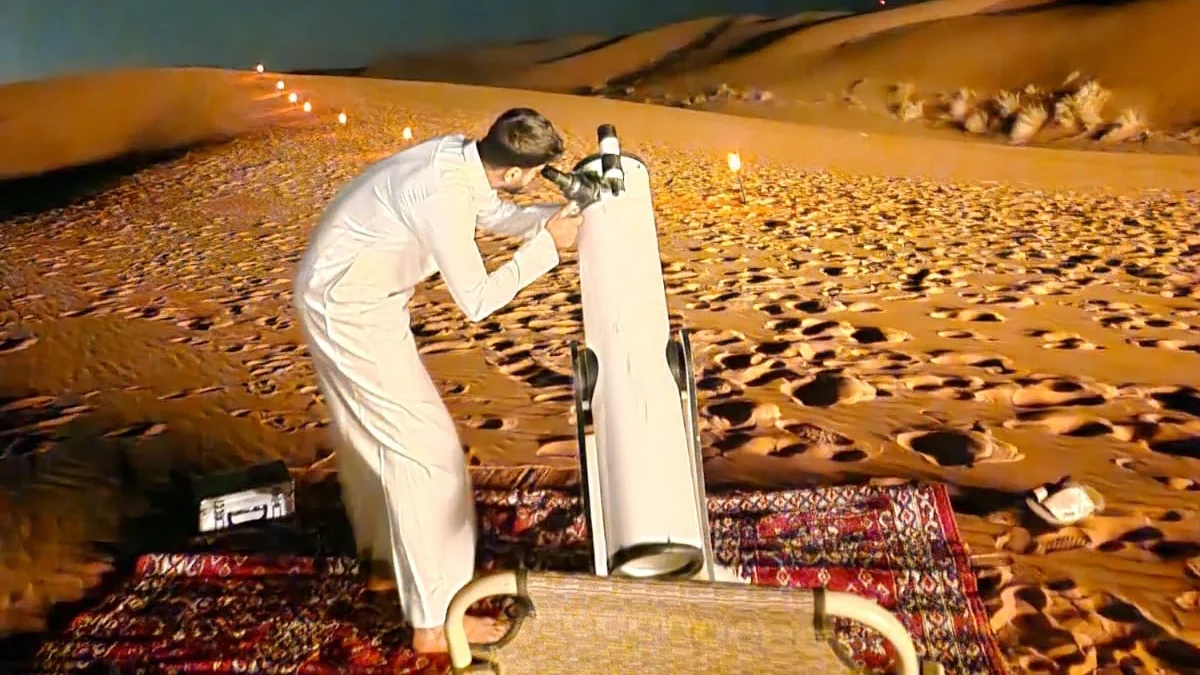
Riyadh Desert Safari’s stargazing programme advertises an eight-hour outing at a camp east of Riyadh, with an 8-inch Newtonian telescope and astronomy guides. Dinner, refreshments, camp facilities and separate male/female toilets are listed. Transport is excluded and available on request.
The eight hours cover the whole outing, not continuous telescope use. Before paying, confirm the session length, group size, viewing arrangements and which objects should be above the horizon on your date. Ask whether nearby camp lights can be dimmed during observing.
The listing accepts enquiries rather than showing confirmed seats for a selected departure. Get the date, meeting point, transport price, finish time and cloudy-weather policy in writing. Do not treat the advertised planet, galaxy or nebula descriptions as a promise of what you will see.
Yalla Hike: choose it for a full camp outing
The Red Sand Camp experience on Visit Saudi combines desert activities, dinner and stargazing. It lists transport from a meeting point, outdoor seating and restrooms. The itinerary runs from a 1pm meeting to an 11:15pm return to that meeting point, with departure from camp at 10pm.
Choose it if the group wants a varied afternoon and evening. The description does not specify a telescope or a dedicated observing duration, so confirm both if astronomy is your priority. The meeting point is supplied after booking; do not assume hotel pickup.
The listing flags limitations for people with injuries or mobility difficulties. Confirm suitability, activity participation and the return schedule for your group. A late camp departure is not an overnight stay.
Match the Moon to what you want to see
For faint stars and the Milky Way, choose a dark observing window with little moonlight and a clear view away from strong artificial lighting. NASA’s site-selection guidance explains why local lights, the direction you look and weather all matter. There is no fixed drive time from central Riyadh that guarantees a dark sky.
The Moon is also a rewarding target. NASA’s Moon-viewing guide recommends looking near the boundary between lunar day and night, where shadows make surface features easier to see. You do not need to abandon an evening just because the Moon is visible; choose the observing target accordingly.
| Your aim | Plan around |
|---|---|
| Faint stars or Milky Way | Low moonlight, full darkness, a clear horizon and minimal glare in the direction of your target. |
| Moon details | A visible Moon and suitable binoculars or a telescope; the light–dark boundary reveals texture. |
| Meteor watching | A wide view of the sky and a long, comfortable session; a telescope is not the main tool. |
| A first family session | A manageable finish time, seating, toilets and a guide who can explain a few visible targets. |
Check the whole observing window
Sunset marks the start of twilight, not immediate full darkness. Check the end of astronomical twilight, the Moon’s rise and set times, and your target’s position for the actual location and date. A new-moon date alone does not tell you when a particular object will be visible.
Use the U.S. Naval Observatory’s Moon-phase service for phase dates; its output uses Universal Time, so convert to Riyadh time, UTC+3. For the sky above your destination, set an interactive sky map to the correct place, date and hour. NASA’s beginner guide links to Stellarium Web and explains how sky maps help identify visible objects.
For trip comfort, consult Best Time to Visit Riyadh, then check the actual forecast. Review NCM early warnings for the route and return journey. Cloud, blowing dust, wind or unsuitable access can change the plan even when the lunar timing looks promising.
Meteor dates worth planning around in late 2026
The American Meteor Society calendar lists the following peak nights. These are planning dates, not a guarantee of a display or an organised local event. Check the current forecast, Riyadh-area Moon times and your operator’s observing window closer to departure.
| Shower | Listed peak night | Planning advice |
|---|---|---|
| Orionids | 21–22 October 2026 | A bright waxing Moon can obscure fainter meteors while it is above the horizon. |
| Leonids | 16–17 November 2026 | Check moonset and allow a late session; do not book expecting a meteor storm. |
| Geminids | 13–14 December 2026 | A strong annual shower with a crescent Moon this year; a useful date to prioritise if conditions cooperate. |
Our pick: give the Geminids enough time
If you want to plan one meteor outing from this list, prioritise the night of 13–14 December and keep the plan flexible for weather. Confirm a session that extends well into the night. A camp trip that leaves at 10pm may finish before the observing time you want.
Take a reclining chair or mat and watch a broad area of sky without a telescope. Give the session time; short quiet spells do not mean the shower has ended. Do not buy a trip on the promise of a fixed number of meteors per hour—conditions and what you happen to catch vary.
Set up for better views
Give your eyes about 30 minutes to adapt and avoid bright phone screens or headlights. NASA’s beginner advice recommends red lighting to help preserve night vision. Keep it dim and directed at what you need to see; use enough light to move safely.
Ask the guide to place the observing area away from vehicles, floodlights and activity areas. Keep the group together and let staff handle telescope alignment. For a first session, a few clearly explained targets are more useful than a long list of objects rushed between dinner and departure.
If the Milky Way is your goal, ask which part should be visible and when. The bright central region is not an all-year, all-evening target. A dark location helps, but the season, horizon, Moon and conditions still decide the view.
Pack for sitting still after dark
| Bring or confirm | Why it helps |
|---|---|
| Warm layers and a blanket | Choose them for the site’s overnight forecast; sitting still can feel chilly. |
| Comfortable seating | A reclining chair or mat makes a longer observing session easier. |
| Water and personal essentials | Confirm refreshments and carry necessary medicines. |
| Light and power | A dim red torch for observing, suitable light for walking, a charged phone and backup power. |
| Optics if useful | Binoculars are optional; ask what the guide provides before buying or carrying a telescope. |
Confirm night access and the journey home
A daytime viewpoint, a dark patch on a light-pollution map or a reserve activity listing does not establish after-dark access. Confirm the actual observing site, entrance, permissions, closing arrangements and return transport for your booking. Avoid unfamiliar off-road approaches or exposed cliff edges after dark.
Use the desert safety guide for weather, communications and emergency preparation. If you want to sleep outside, arrange it separately using the desert camping guide; a stargazing ticket does not establish camping permission.
For more outings, browse the Outdoors hub, or return to Travel Guides to plan your stay.
Continue exploring
Frequently asked questions
Does every Riyadh stargazing tour include a telescope?
No. Riyadh Desert Safari lists an 8-inch Newtonian telescope; the Yalla Hike camp listing includes stargazing without specifying one. Confirm the equipment and observing duration before paying.
How far should I drive from Riyadh for a dark sky?
There is no guaranteed distance or drive time. The exact site, nearby lights, viewing direction, weather and Moon all matter. Confirm permitted access and the return route.
Is a new-moon night always best?
Low moonlight helps with faint stars, but check the actual observing window and target. For lunar details, choose a time when the Moon is visible.
When are the Geminids in 2026?
The American Meteor Society lists the peak night as 13–14 December 2026. Arrange enough observing time and check local weather and Moon times; sightings are not guaranteed.
Can I see the Milky Way on any desert evening?
No. Its position, the part you want to see, season, Moon, local lighting and weather matter. Ask your guide what should be visible during your actual session.
Can I stay overnight after stargazing?
Only with separately confirmed accommodation or appropriate camping permission. Check the return time and do not assume an evening camp programme includes sleeping there.
Useful links & sources
- Riyadh Desert Safari: Newtonian telescope programme
- Visit Saudi / Yalla Hike: Red Sand Camp programme
- NASA: choosing an observing location
- NASA: beginner sky maps and dark adaptation
- NASA: observing the Moon
- U.S. Naval Observatory: Moon phases and time format
- American Meteor Society: 2026–2027 shower calendar
- NCM: current early warnings